

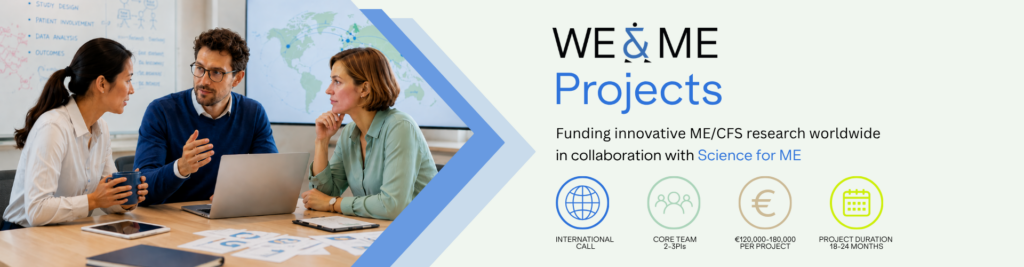
The Ströck family’s WE&ME Foundation has launched a new call for research proposals on the multisystem disease ME/CFS. In addition to projects already underway, a total of approximately two million euros in new funding will be made available. The call for research proposals is being coordinated by the Vienna Science, Research, and Technology Fund (WWTF). Several biomedical projects are to be funded, WWTF program manager Benjamin Missbach told the APA.
The funding call is being administered by the WWTF on behalf of the foundation and is intended for several international projects. In the first round, six to seven smaller projects will be funded. These are scheduled to run for up to two years starting in early 2027, with approximately one million euros available for this purpose. For the best of these projects, further funding with a higher budget totaling approximately one million euros is planned. In addition, over the next four years, two young researchers will be honored annually with an award for outstanding achievements in the field of ME/CFS, each receiving approximately 5,000 euros.
International Panel of Experts
Applications for this research grant, which is funded entirely by private donations, are now being accepted, and awards are expected to be announced later this year. The selection process will be conducted by an international panel of experts led by molecular biologist and ME/CFS specialist Mauren Hanson of Cornell University in New York.
Also serving on the board are David Putrino, a post-COVID expert and professor of rehabilitation at the Icahn School of Medicine (Mount Sinai, New York); geneticist Chris Ponting of the University of Edinburgh; and immunologist Michal Tal of the Massachusetts Institute of Technology (U.S.).
Ströck: Patient Involvement Is Crucial
The WE&ME Foundation particularly emphasizes that the jury also includes three patient representatives (plus two alternate members). “We need a funding structure in which the voices of those affected are not only heard but also institutionally supported,” emphasized Christoph Ströck of the WE&ME Foundation—who himself suffers from severe ME/CFS—in a written statement to the APA. “That is why we designed the WE&ME Call from the very beginning to ensure that the patient perspective is structurally embedded. Our partner, Science for ME—the leading international ME/CFS patient forum—has helped shape the call from the very beginning and is part of the international jury. This is unusual in research funding, but it is exactly how it needs to be for ME/CFS.”
“Patients are critical, detail-oriented, and have high expectations,” said Ströck. “No one has a stronger incentive to select the best research than the patients themselves. When patients also bring expertise in relevant fields, this provides a particularly strong foundation for excellent funding decisions.” Her comments are usually “precise and ultimately lead to better research results.”
Another WE&ME Award Set to Launch
In July, it will also be announced which project will receive the 450,000-euro grant, which is also funded by the WE&ME Foundation and awarded in collaboration with the Austrian Science Fund (FWF).
“A Real Gap” in Government Research Funding
Current government funding for ME/CFS research in Austria is modest by international standards—especially when compared to Germany: Since 2024, a study funded by the Austrian Science Fund (FWF) with just under 300,000 euros over three years has been underway on endothelial dysfunction (affecting the inner layer of blood vessels, note) in ME/CFS and post-COVID. In addition, research is primarily privately funded through the WE&ME Foundation.
By way of comparison: In Germany, the “National Decade Against Post-Infectious Diseases”—which was approved last year to fund research into conditions such as ME/CFS and post-COVID—was launched in 2026. A total of 500 million euros is earmarked for this initiative over ten years.
“For years, there has been a real gap in research funding for ME/CFS and PAIS, which we have been addressing since 2024 in collaboration with the WE&ME Foundation and through a large number of private donations,” WWTF Program Manager Missbach told the APA. “In the future, targeted, quality-assured funding and the involvement of patients and their representatives will be needed—and not just from the WWTF and the WE&ME—to ensure that research continues to move forward.”
Projects totaling approximately 3.1 million have been funded to date
In addition to the new grants mentioned above, the WE&ME Foundation—in cooperation with the WWTF—has been launching and funding several projects since 2024. Approximately 3.1 million euros have been or are currently available for these projects: This includes the continuation of existing projects in the coming year (2 million euros), funding for the ME/CFS biobank at MedUni Vienna with approximately 200,000 euros, and, in addition, six “fellowships” for young researchers with a total budget of 233,000 euros were launched this year.
Regarding the new call for research proposals, Ströck reported a “broad, international, and positive response that our call is already receiving.” This shows “that researchers, patient advocates, and funders are increasingly speaking with one voice—and that voice is growing louder.”
Source: APA, published on June 23, 2026.
Click here to continue to the WE&ME Projects call for proposals.