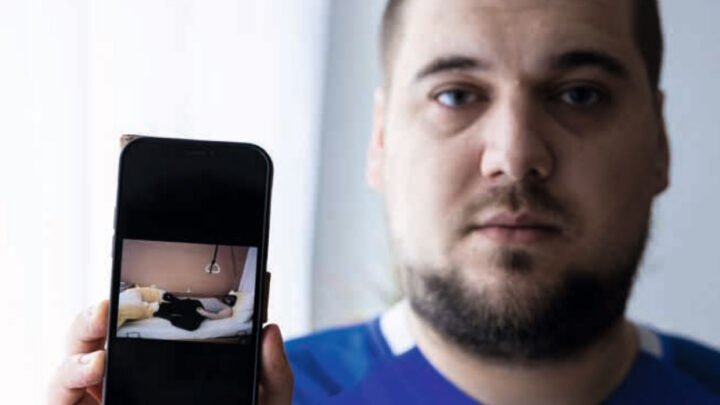
Martin’s story is one of hope. He has been living with ME/CFS since 2017. After 10 months, at the age of 24, he became almost completely bedridden – he was unable to leave his wheelchair more than once a day to go to the toilet. Martin was in this condition for four years. “I got sick in the prime of my life. But I take it as it comes,” he says. Today, Martin is playing basketball again, taking care of a move himself, and looking for a part-time job. Why is he doing so much better?
At first, things didn’t look good for Martin: when he fell ill, he was living at home with his parents. But his mother urged him to finally become more active again. No wonder: even doctors don’t believe Martin. He is told that he is faking it and that he should pull himself together. This is exactly the wrong thing to do with ME/CFS—a condition in which any overexertion can lead to a permanent deterioration of the patient’s condition. Martin decides to break off contact with his mother and moves into a supervised shared apartment.
There, the staff is there for him around the clock. They accept his limitations, help him with personal hygiene, and bring him meals in bed. “I always hoped that there was still a medication I hadn’t tried yet,” he says.
At some point, that hope became reality. When Martin started taking low doses of aripiprazole (LDA) and naltrexone (LDN), things started to improve. Step by step, his condition improved. At some point, this hope became reality. When Martin starts taking low-dose aripiprazole (LDA) and naltrexone (LDN), things start to look up. Step by step, his condition improves.
Nowadays, you can hardly tell that Martin is ill. He needs a few more breaks after exerting himself. Long walks and sports—Martin was a passionate soccer player—are still only possible to a limited extent. “I miss that,” he says.
But during his four years in bed, Martin has lost almost everything. Most of his relationships, whether friendly, romantic, or family, have broken down because of his illness. Martin is often lonely. At least he is back in contact with his mother. She has now come to accept his illness.
Rebuilding a life that you have lost without dying is still not easy. Martin, for example, has to have diagnoses revoked that he never had. The Pension Insurance Institution (PVA) granted him a disability pension on the basis of an alleged mental illness. But ME/CFS is a neuroimmunological multisystem disease—in other words, physical. Without Martin’s mental stability, resilience, and humor,
his past would have broken him. Now he wants the PVA to declare him fit for work again so that he can look for a job. Navigating the bureaucratic jungle and dealing with the uncertainty are challenging.
The shared apartment where Martin lived is actually intended for people with mental illness. The misdiagnosis of ME/CFS often leads to incorrect treatment and drives people further into illness. Fortunately, the staff at the shared apartment treated Martin correctly and believed him. So, on the day he was photographed by Brent Stirton, Martin was able to move into a new shared apartment with less supervision. Another step back into life.